📍 Quick Facts & Useful Info
🧭 Open in MapsLocation📍 Sicily
Accommodations nearby🏡 10 Mare In holiday resorts starting from 58.7 km
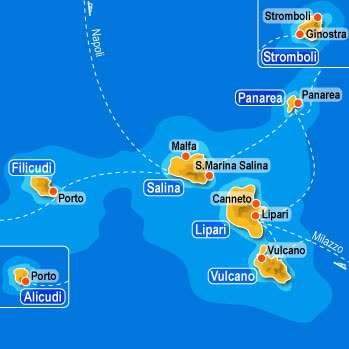
The Aeolian Archipelago, located in the southern Tyrrhenian Sea northeast of the Sicilian coast, consists of seven main islands of volcanic origin, historically known as the "Seven Sisters." The place name derives from the mythological figure of Aeolus, the god of the winds, whom the Homeric tradition of the *Odyssey* identified as the ruler of these islands. In 2000, the archipelago was inscribed on the UNESCO World Heritage List for the exceptional geological and volcanological significance of its eruptive phenomena.
The seven islands each have distinct morphological, landscape, and environmental characteristics:
• Lipari: It is the largest, most extensive, and most populous island in the archipelago, as well as its main administrative, tourist, and commercial hub. Dominated by the fortress of Lipari Castle (home to the Luigi Bernabò Brea Aeolian Archaeological Museum), it is famous for its ancient obsidian and pumice deposits, which give the seabed of Spiaggia Bianca and Canneto Bay an intense turquoise color, as well as for the striking Faraglioni of Pietra Lunga and Pietra Menalda.
• Salina: It is the second-largest island and the one with the richest vegetation and the most freshwater springs. Its silhouette is defined by two twin extinct volcanoes, Monte dei Porri and Monte Fossa delle Felci (which, at 962 meters, is the highest peak in the entire archipelago). It is renowned for the spectacular volcanic bay of Pollara, for the cultivation of DOP capers, and for the production of Malvasia delle Lipari DOC passito wine.
• Vulcano: It is the southernmost island and the one closest to the Sicilian coast, characterized by secondary volcanic features such as fumaroles, hot underwater thermal springs, and sulfur mud pools. Its main crater ("Gran Cratere della Fossa"), which can be reached via a scenic hike, is in a state of permanent fumarolic activity. The picturesque Sabbie Nere Beach, made up of very fine, dark volcanic sand, is very popular.
• Stromboli: It is the northernmost island and home to one of the world’s most active volcanoes, characterized by persistent explosive activity (known as “Strombolian”) at regular intervals. Incandescent lapilli and lava flows cascade down the Sciara del Fuoco, a steep lava slope that descends all the way to the sea—a particularly striking sight to behold from a boat at sunset. The island features sandy beaches and black pebble beaches (such as Ficogrande and Piscità), the volcanic rock formation of Strombolicchio, and the picturesque, isolated village of Ginostra.
• Panarea: It is the smallest and geologically oldest island in the archipelago. Known for its characteristic architecture featuring white houses, its lively summer scene, and the stunning bay of Cala Junco (overlooked by the ruins of the prehistoric village of Punta Milazzese), it is surrounded by a micro-archipelago of islets and volcanic rocks, including Basiluzzo, Dattilo, Lisca Bianca, and Bottaro.
• Filicudi and Alicudi: Located on the western side, these are the wildest, quietest, and least developed islands, characterized by sheer rocky cliffs and ancient agricultural terraces. Filicudi is famous for the Grotta del Bue Marino and the imposing volcanic neck of La Canna (a rock that rises 71 meters out of the sea), while Alicudi retains a timeless atmosphere, with no roads open to traffic or motor vehicles.
ℹ️ Services and Accommodations:
The availability of services and accommodations varies significantly from one island to another. Lipari, Salina, Vulcano, and Panarea offer a wide and well-developed range of accommodations, including hotels, vacation rentals, apartments, restaurants, diving centers, boat rentals, and beach clubs. Boat tours depart daily from all the islands for coastal cruises and nighttime viewing of the Sciara del Fuoco on Stromboli. Filicudi and, above all, Alicudi, on the other hand, offer essential services and more intimate accommodations, ideal for those seeking absolute tranquility and direct contact with nature.
🚗 How to get there:
The main ferry routes to the Aeolian Islands operate year-round from the Sicilian port of Milazzo (the nearest and most well-served departure point), via high-speed passenger-only hydrofoils and car ferries. Other regular or seasonal routes operate from the ports of Messina, Palermo, Cefalù, Reggio Calabria, Vibo Valentia, Tropea, and Naples (using both summer hydrofoils and overnight ferries). The main airports are Catania Fontanarossa, Palermo Punta Raisi, and Reggio Calabria, which are connected to the port of Milazzo via direct shuttle buses and transfer services. During the summer months, specific municipal restrictions apply to the landing and movement of cars and motorcycles owned by non-residents on most of the islands.
💡 Fun fact:
1. Black obsidian and white pumice from Lipari: Since the Neolithic period, Lipari has been one of the most important centers in the Mediterranean thanks to the export of obsidian, a sharp, black volcanic glass used by ancient peoples to make tools and blades. On the northeastern side of the island, however, the deposits of white pumice—mined for centuries—have created a unique color contrast with the dark lava flows and have made the crystal-clear waters off Spiaggia Bianca famous.
2. Great Art House Cinema Between Salina, Stromboli, and Panarea: The archipelago has served as the backdrop for masterpieces in the history of cinema: in 1949, Roberto Rossellini filmed the famous movie "Stromboli (Land of God)” on the island, starring Ingrid Bergman, while in 1994 Massimo Troisi chose the volcanic cliffs of Pollara and the houses of Salina for the unforgettable scenes in “Il Postino.” Michelangelo Antonioni's *L'Avventura* (1960) and an episode of Nanni Moretti's *Caro diario* (1993) were also set among the islands of the archipelago.
3. Car-free islands, the mules of Alicudi, and the village of Ginostra: There are no cars on Alicudi and Panarea (nor in the village of Ginostra on Stromboli). There aren't even paved roads on Alicudi: the only way to get from the small harbor to the homes scattered along the slopes of the volcanic cone is to walk up the ancient lava-stone stairways (“mulattiere”), while luggage and goods are still transported by mule to this day. In Ginostra, a hamlet of Stromboli that is isolated from the rest of the island and accessible only by sea, there is also one of the smallest harbors in the world (“Pertuso”), which can accommodate only one boat at a time.
📍 Location Map
Geographic Location
Would you like to stay near these places full of charm and curiosity? Fill out the form to receive our best proposals.
📬 Request a quote
Enter your contact details to be reached back with no obligation.
🏷️
Best Price Guaranteedlower than other portals
🚢
Ferry discounts up to 30%included in your package
⚡
Free quote in 2 hourswith no obligation
🏡 Where to stay
Recommended Holiday Resorts

Sant'Agata di Militello Residence
📍about 58.7 km from here

Gioiosa Marea Residence
📍about 60.5 km from here

Patti Residence
📍about 66.4 km from here

Cefalù Costa Verde Water Park & SPA Hotel
📍about 71.7 km from here

Cefalù Vacation Rentals
📍about 72.2 km from here

Residence San Saba
📍about 96.5 km from here

Taormina - Letojanni Tourist Village
📍about 107.4 km from here

Giardini Naxos Tourist Village
📍about 110.1 km from here

Capo Vaticano Agriresort
📍about 119.6 km from here

Tropea, Olivara Village
📍about 125.6 km from here